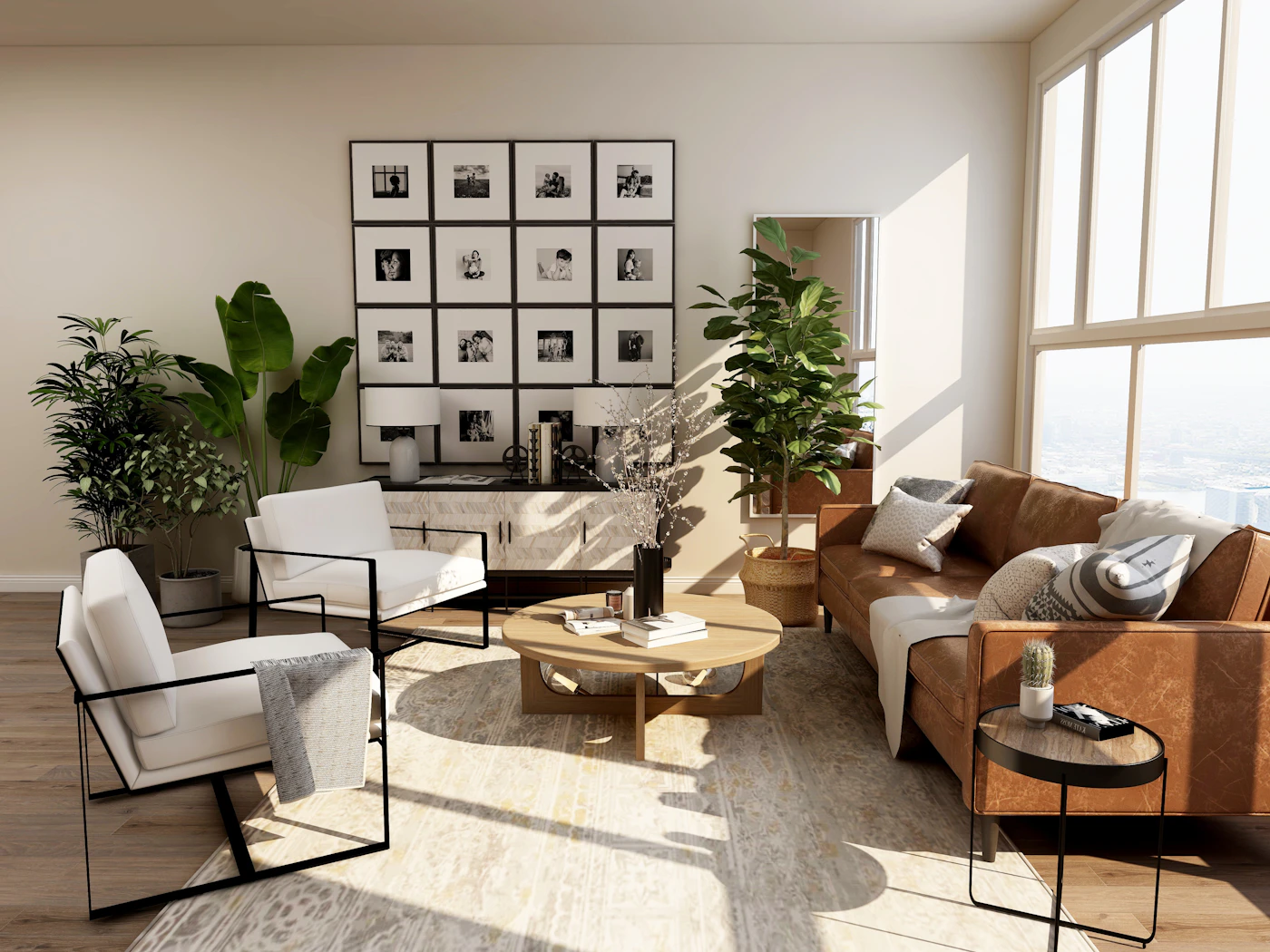
A studio's biggest design problem isn't square footage — it's that every activity happens in the same visual field. Sleeping, working, and relaxing all sit in one open box, and without some way to separate them, the whole apartment can start to feel like one long, undifferentiated room rather than a home with distinct parts. The instinct is to reach for a wall, or at least a room divider. Most of the time, neither is necessary.
Let the rug draw the boundary
A rug is the fastest way to define a zone without touching the architecture. Placing a rug under the seating area — and stopping it short of the kitchen or the bed — tells the eye exactly where that zone begins and ends, even with nothing physically blocking the sightline. The trick is committing to a rug large enough that the front legs of every seating piece sit on it; a rug that's too small just floats in the middle of the space and reads as an accessory rather than a boundary.
Use lighting temperature to separate 'day' and 'night' zones
Overhead lighting treats the whole studio as one room. Swapping to zone-specific lighting — a floor lamp by the reading chair, a pendant over a small desk, a dimmable sconce by the bed — lets you light one part of the apartment while the rest goes dark, which does more to psychologically separate 'work mode' from 'off mode' than almost any furniture arrangement. This is especially useful in the evening, when overhead light makes the whole studio feel like it's still in daytime work mode.
Turn furniture backs into soft walls
A low bookshelf, a console table, or the back of a sofa can stand in for a wall's job — not blocking light or sightlines entirely, but giving each zone an edge to define itself against. The key is picking furniture no taller than roughly shoulder height when seated; anything taller starts to feel like an actual partition and can make a small studio feel boxed in rather than zoned.
Keep one sightline completely open
With all this zoning, it's tempting to divide the studio into as many distinct areas as possible. Resist it. At least one long sightline — usually from the entry to the window — should stay completely clear of furniture. That uninterrupted view is what keeps a zoned studio feeling like one apartment with organized parts, rather than a maze of competing rooms crammed into four hundred square feet.
